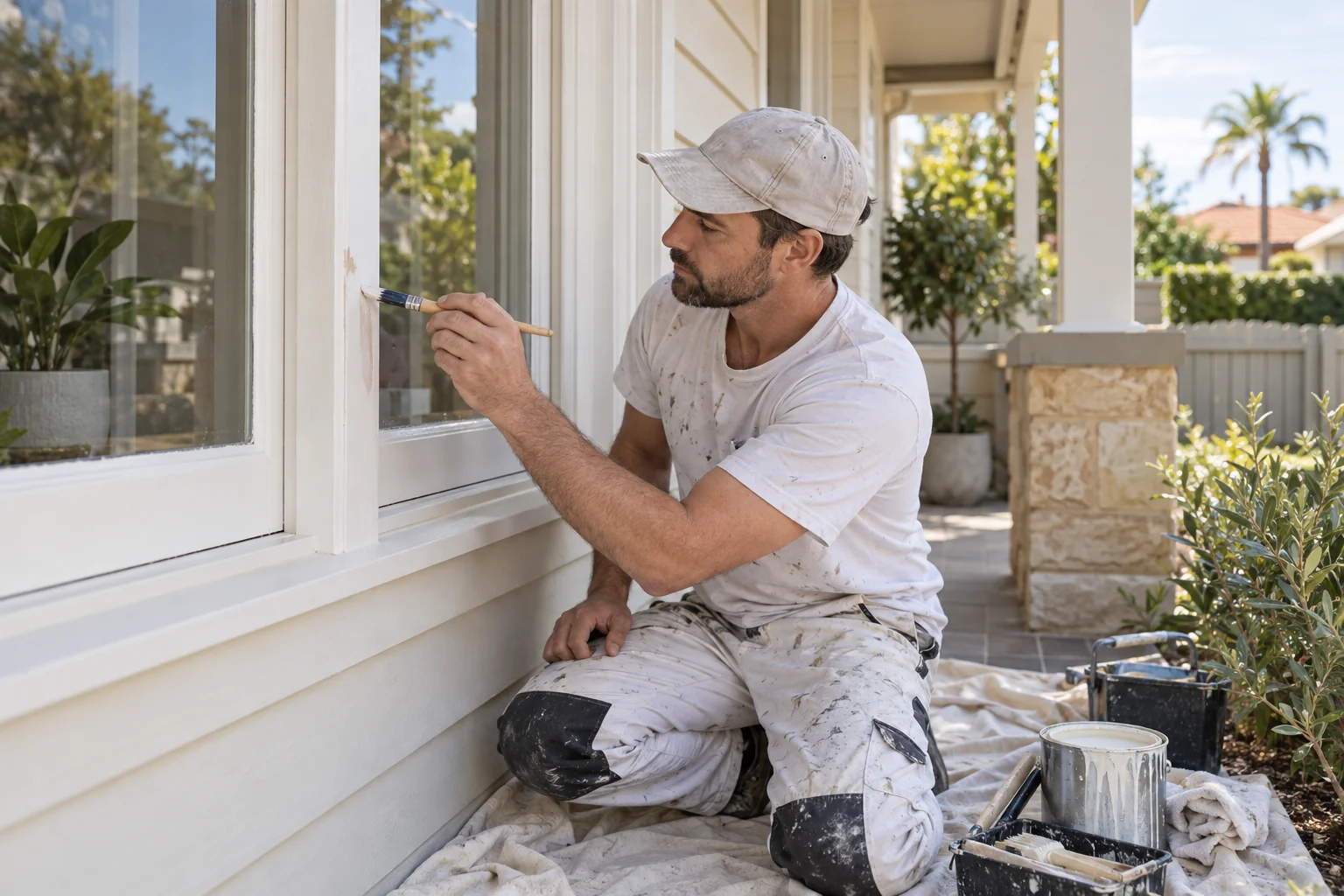
How professionals prep walls
The professional prep sequence
Clean & degrease
Wash off dust, grime, grease and (outdoors) salt and mould. Paint will not bond to a dirty surface.
Repair
Fill cracks, nail holes and dents; re-caulk gaps; replace rotten timber and rusted fixings.
Sand
Sand filler flush and dull any glossy areas so the new coat has a sound surface to grip.
Seal stains
Spot-seal water stains, smoke and tannin so they do not bleed through the finish.
Prime
Prime bare, repaired or porous areas so the topcoat covers evenly and adheres for the long term.
Mask & protect
Cover floors and furniture, mask edges and trims, then a final wipe-down before painting.
Interior vs exterior prep
Interior prep focuses on a flawless finish: filling fine cracks and nail holes, sanding smooth, sealing stains and protecting furniture and floors. Exterior prep is heavier and weather-driven: pressure-washing, scraping failed paint, treating mould and rust, filling render cracks and priming bare substrate – all before the UV-stable system goes on. Exteriors also depend on dry weather, so timing matters.
Prep mistakes that cause early failure
- Painting over dirt or grease – the new coat cannot bond and soon peels.
- Not sanding gloss – fresh paint slides off a slick surface.
- Painting damp or salty walls – moisture and salt lift the film from behind.
- Skipping primer on bare patches – uneven sheen, poor adhesion and flashing.
- Rushing between coats – each coat needs to cure before the next.
Good prep is the difference between a repaint that lasts the full cycle and one that fails in a few years. It is also why a suspiciously cheap quote is rarely a bargain – see our house painting cost guide.
Wall preparation FAQs
How do professionals prepare walls before painting?
They clean, fill and sand the surface, seal stains, prime bare or repaired areas, then mask and protect before the first coat.
Do you need to sand walls before painting?
Usually yes. Sanding removes imperfections and gives the new paint a sound surface to grip, especially over gloss or patched areas.
Can you paint over old paint without prep?
Only if the surface is clean, sound and dull. Painting over dirt, gloss, damp or flaking paint causes early failure.
How long does wall prep take?
On a repaint, preparation is often 30 to 50 percent of the total time, and it is what makes the finish last.
Want it prepped and painted properly?
We do the prep the finish depends on, then paint to a flawless result – all set out in a free, fixed, written quote, usually within 48 hours.
Get a fixed written quote Call 0402 214 353